
Good Friday

 Good Friday 

Good Friday is a very important day for all Christians. On Good Friday, Christians remember that Jesus died for everyone. He was crucified by the Romans on a hill outside Jerusalem although he had not done anything wrong. When a person was crucified, they were tied and nailed by the wrists and feet to a large wooden cross or scaffold and left to die. This is why a cross if often used as a symbol of the Christian faith.
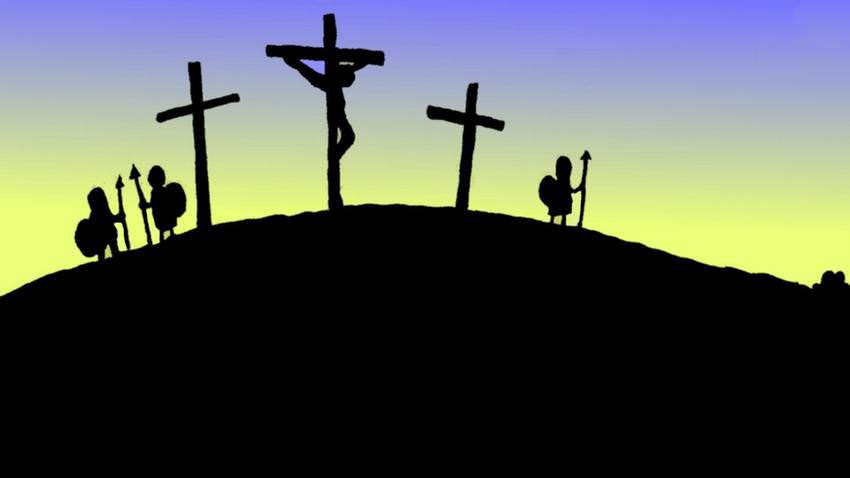
The 'Good' in Good Friday comes from old English when Good meant Holy. So you could call Good Friday, 'Holy Friday'.
There are parades all over the world to celebrate and remember Good Friday. In Spain and some other countries, people who are very sorry for their wrong doings (called 'Penitents') walk through the streets wearing long robes with hoods and carrying a big cross of wood.
In some countries, including the U.K., sometimes a single person or group of church members carry a large wooden cross, around the streets near the church, before the Good Friday service. They may be also followed by the rest of the people going to church. Sometimes they will stop and have a reading from the Bible or sing a song before going to the service.
In some Central and South American countries there will be a procession of statues to the church before the service. These are often statues of Jesus, Mary and other saints. In Greece, people go to the church in a procession as if they were going to a funeral. Some Orthodox and Catholic churches have models of tombs as the centre piece of the service to help people remember Jesus died.
In most Anglican churches, there are no flowers or decoration such as alter-cloths in the church on Good Friday.
One of my favourite Good Friday customs is Hot Cross buns! These are yeast dough buns with currants and raisins in them and they have a cross on the top. You can eat them cold. I prefer to cut them in half, toasted with butter and jam on!

Comments

Popular posts from this blog

Krishna Janmashtami

Krishna Janmashtami Janmashtami is a popular festival of the Hindus that revolves around the celebration of the birth anniversary of Lord Krishna. This festival usually falls in the month of August or September.  In 2018, it is going to be celebrated on Sunday , 2 September. About Lord Krishna and Janmashtami History Krishna is considered to be one of the most powerful incarnations of Lord Vishnu, who was born into this world to help people get rid of evil demons. Janmashtami’s history dates back to several thousands of years when Lord Krishna was born to Devaki and Vasudevaa, who were imprisoned by his maternal uncle Kansa, the king of Mathura. Lord Krishna's Childhood Days There are various stories of Lord Krishna, which speak about his feats during his childhood. According to one such story, Krishna had killed lady demon, Putna and various other demons like Trunavarta, Aristhasur, and Keshi. He’s also famous for killing Kaliya Nag in order to remove poison fr...

Parsi New Year

Pateti - Parsi New Year Navroz or Pateti is the Parsi New Year and it is celebrated on the eve of New Year of the Zoroastrian calendar. On pateti day the parsis visit the fire temple or agiary. The agiary is called as a fire temple because the sacred fire which was brought from Iran once upon a time is always kept burning in the temple by the high priest. The parsis worship Ahura Mazda, symbolised by fire. The parsis on this day, promise to live with good thoughts, use good words and perform the right actions.                                          The word pateti is derived from Pazend patet, meaning 'repentance'. The Zoroastrian tenets are based on the three ideals of good thoughts, good words and good deeds. Anything that is out of accord with this is considered a sin.It is natural for anyone to have committed a sin in the course of a year, even if only inadvertently. Pa...

Bhaiya Dooj

Bhai Dooj: Brother-Sister Ritual Nowhere is the bond of brotherly-sisterly love glorified with such grandeur as in India. Hindus celebrate this special relationship twice every year, with the festivals of Raksha Bandhan and Bhai Dooj. What, When and How After the high voltage celebrations of Diwali, the  festival of lights  and firecrackers, sisters all over India get ready for 'Bhai Dooj' - when sisters ceremonize their love by putting an auspicious  tilak  or a vermilion mark on the forehead of their brothers and perform an  aarti  of him by showing him the light of the holy flame as a mark of love and protection from evil forces. Sisters are lavished with gifts, goodies, and blessings from their brothers. Bhai Dooj comes every year on the fifth and last day of  Diwali , which falls on a new moon night. The name 'Dooj' means the second day after the new moon, the day of the festival, and 'Bhai' means brother. Myths and Legen...